San Francisco Condo Market Report: October 2026 Outlook
Sean Mamola | October 12, 2026

Sean Mamola | October 12, 2026
Two out of every three condos that closed in San Francisco in September sold for more than their asking price. A year ago it was closer to one in three. The condo median landed at $1,355,500, up 23% from last September, and condos spent 32 days on the market on average, 28% less time than a year earlier.
That's a strong set of condo numbers by any measure. It's also a little stale already. Most of those deals were negotiated in August, when a 30-year mortgage cost about 6.7%. On October 8, Freddie Mac's weekly average hit 7.40%.
So this month's report is really two stories. One is what the market did. The other is what it's about to be tested by.
San Francisco, September 2026 | Condos | Single-family houses |
|---|---|---|
Closed sales | 230 (-2% YoY) | 191 (+4% YoY, +23% MoM) |
Median sale price | $1,355,500 (+23% YoY) | $2,050,000 (+17% YoY) |
Sold over list price | 66% (+27 pts YoY) | 92% (+17 pts YoY) |
Average days on market | 32 (down 28% YoY) | 16 (was 23) |
Months of supply | 2 | 1 |
Active listings, end of month | 521 (-33% YoY) | 237 (-18% YoY) |
Price reductions | 58, nearly double last year | Down 42% YoY |
Source: Compass International Holdings, October 2026 report (data through September 2026). September figures are preliminary, and late MLS reporting can add closings for about two weeks after month-end.
Compass's own bottom line is "a very tight single-family market and a condo market that is clearly competitive." I'd agree with that, and I'd add that this is the first month in a long time where I didn't have to qualify the condo half of the sentence.
Last month I put an asterisk on the condo growth rate, because August 2025 had been one of the weakest condo months of the year. That made the comparison easy.
September doesn't need the asterisk. Last September's condo median was around $1.1 million, a normal month rather than a soft one. Beating it by 23% is a real gain. And the month-over-month move tells the same story: Compass has both the condo and house medians up 11% from August.
The run of months matters more to me than either percentage. The condo median dipped through early summer, as it usually does, and September brought it back up near the spring high. If it holds there through October and November, this year's recovery is a level, not a season.
The share of condos selling over asking went from 54% in August to 66% in September. A year ago it was 39%. Compass singles San Francisco out on this measure: condos lagged houses in most Bay Area counties, and San Francisco was the notable exception.
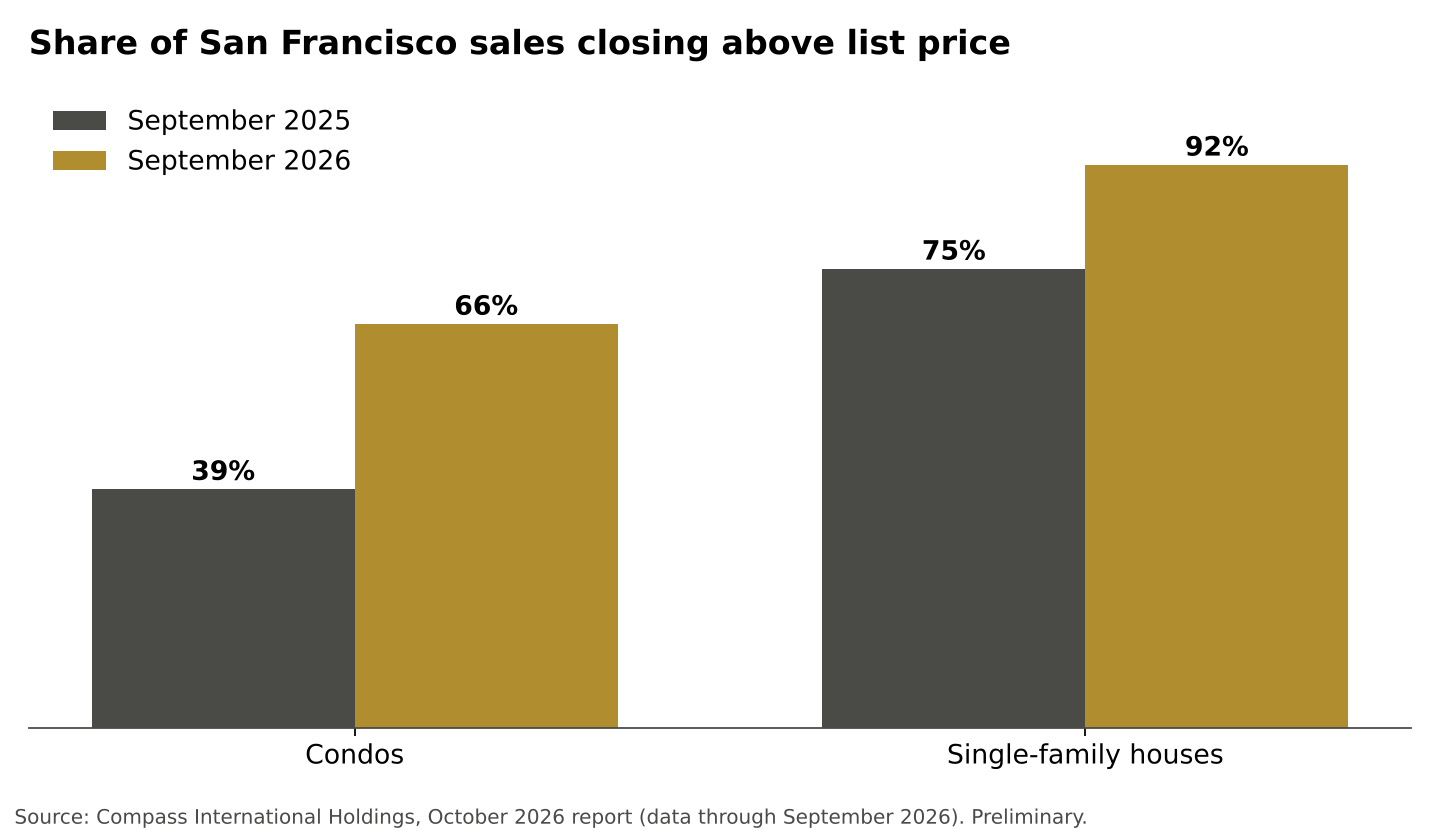
Houses are tighter still. Ninety-two percent of San Francisco houses sold over asking, the highest share in the region, and a house went into contract in 16 days on average. That's one month of supply, which is about as thin as a market gets.
The one number that doesn't fit the pattern is condo price reductions. They nearly doubled from a year ago, to 58. Compass notes that's from a low base, and I'd add that fall is when price cuts usually peak. Even so, it's the clearest sign in this report that the condo market isn't rewarding every seller equally. A strong month for the market isn't a strong month for every listing.
Fall inventory arrived in September. New single-family listings jumped 62% from August, and active house listings rose 49%. Across houses and condos, the city finished September with 758 active listings, up from 570 at the end of August.
That sounds like a lot until you look at the year-ago comparison. Condo listings are still 33% below last September, and house listings are 18% below. Sellers are coming back, but they're coming back into a market that started the fall with almost nothing on the shelves.
Compass frames October as the test: how fast buyers absorb this new inventory decides whether the momentum carries into the fourth quarter. That's the right question. It's also why the next section matters.
In my September report, Freddie Mac's 30-year average was 6.76%. On October 8 it was 7.40%, up from 7.28% the week before and 6.30% a year ago. Compass says mortgage rates rose about 70 basis points during September alone, with the 10-year Treasury pushing to its highest level in roughly 25 years.
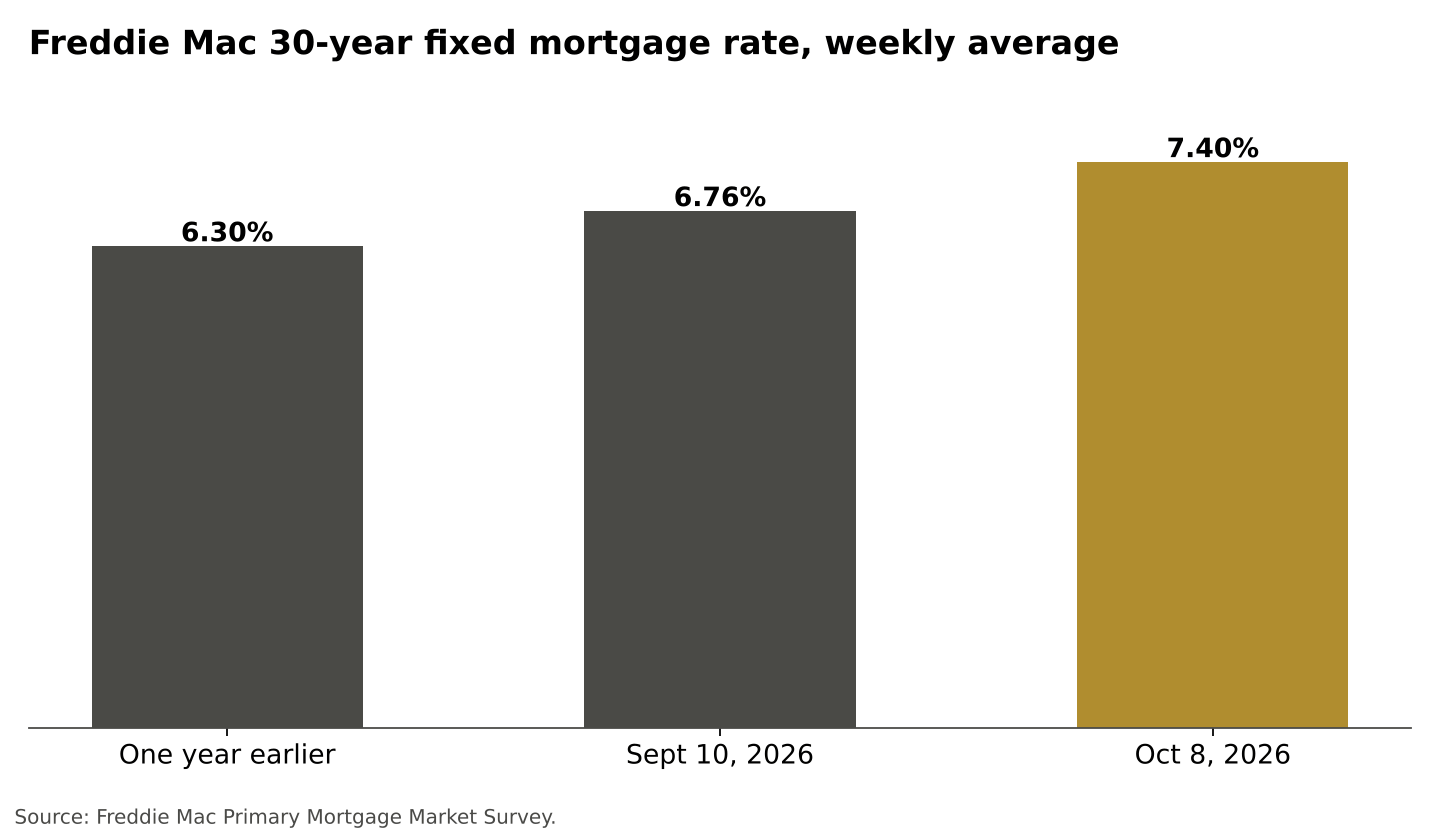
Here's why that doesn't show up in September's numbers. A condo that closed in September was usually in contract in August, and the buyer locked a rate then. The rate jump is an October and November story. It starts showing up in closed sales in the November report, and fully in December's.
I don't expect it to hit every price point the same way. Compass's national data shows sales slowing most at the lower price points, while the top quarter of the market is the only segment still running ahead of last year. Its economist describes the local version as "fewer buyers with far more purchasing power," and that matches what I see. A buyer paying cash for a Pacific Heights condo doesn't care much about 7.40%. A first-time buyer stretching to a $900,000 one-bedroom in Yerba Buena cares a great deal.
If you're buying with a loan, it's worth reading my piece on whether to wait for rates to drop before buying in San Francisco. The short version is that waiting on rates means competing on price later, and this month's competition numbers show what that looks like.
The usual caution first. These are one-month samples, and every neighborhood below had 17 or fewer closings. At that size, one large sale moves the median a long way. Treat this as a snapshot.
Neighborhood | Sept median condo price | YoY change | Sept median condo price per square foot | Sept closings (houses + condos) | Active listings, end of Sept (houses + condos) |
|---|---|---|---|---|---|
$1,115,000 | +17% | $1,195 | 16 | 55 | |
$2,450,000 | +12% | $1,486 | 17 | 21 | |
$1,849,000 | +52% | $1,404 | 7 | 20 | |
$1,498,000 | +13% | $1,259 | 11 | 16 | |
$1,365,000 | +26% | $1,131 | 13 | 24 | |
$1,155,000 | +4% | $1,121 | 7 | 5 | |
$905,000 | -11% | $880 | 14 | 43 | |
$655,000 | -28% | $776 | 3 | 21 |
Source: Compass, October 2026 report. Condo medians and price per square foot are condos only. Closings and active listings combine houses and condos. Small samples, directional only.
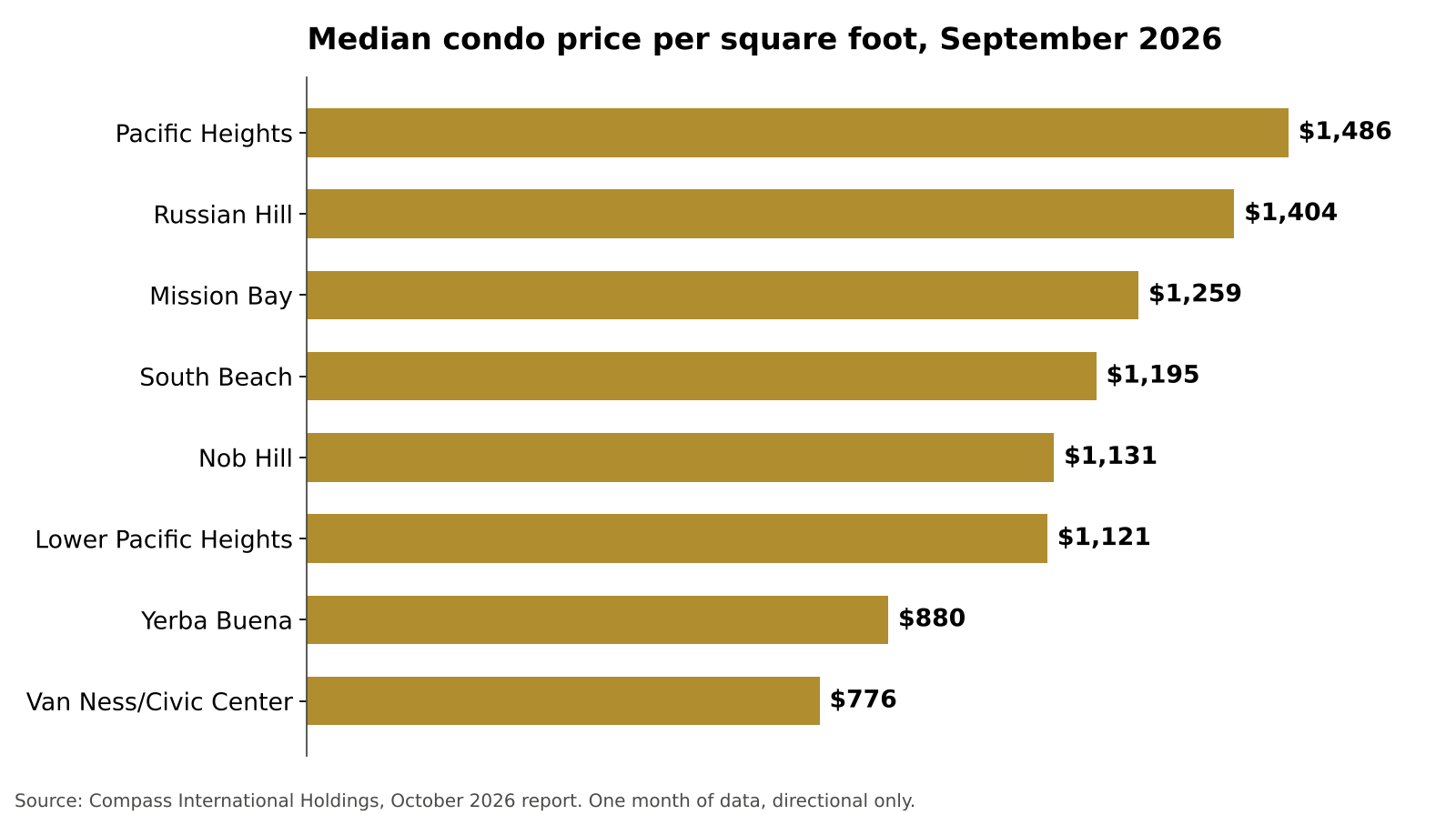
South Beach is the clearest example of why one month doesn't make a verdict. In August its condo median was up 35%. In September it's up 17%, and the median dropped from about $1.49 million to $1.12 million. Nothing about South Beach changed in four weeks. The mix of units that closed did. It's still the busiest neighborhood in the city, with 272 sales over the past 12 months, and still the deepest inventory at 55 listings.
Mission Bay is the one that looks the most like the county. Its condos sold in 7 days on market, 74% faster than a year ago, and the median rose 13%. Lower Pacific Heights was quick too, at 9 days on market, with only five listings on the market at month-end.
Van Ness/Civic Center is moving the other way. Condos there took 73 days on market to sell, and 21 listings sat against three closings. For a buyer who wants to be close to the core and can live with a longer runway on resale, that's where the most room to negotiate is right now.
I said last month that Yerba Buena was the one I'd watch. It still is, but the story got more specific.
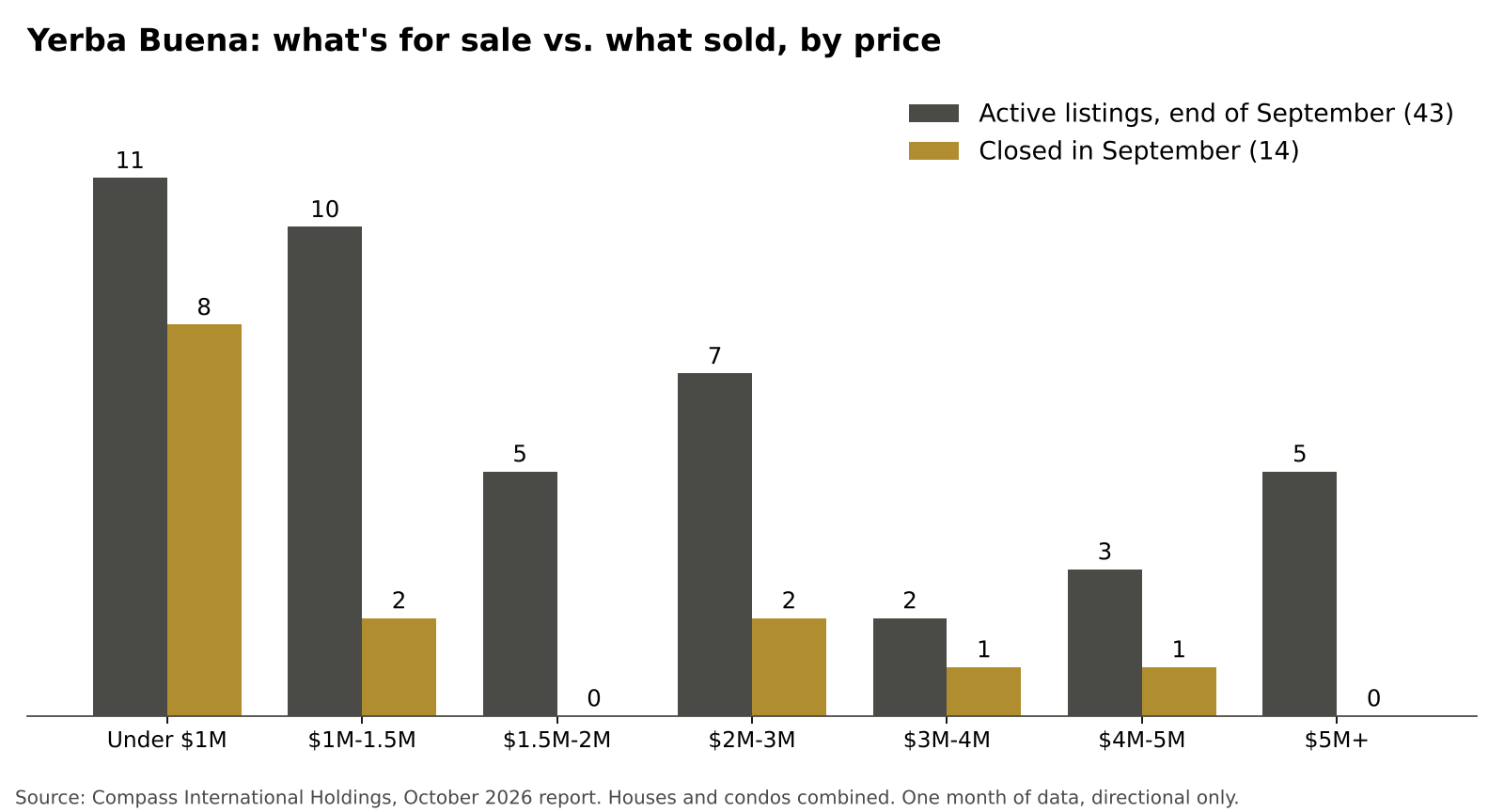
Under $1 million, Yerba Buena is working. Eight of its 14 September sales closed below $1 million, against 11 listings at that price. Above $2 million it's a different market: 17 listings and four sales, including five listings at $5 million and up and no sales there at all. That's what pulled the neighborhood's median condo price down 11% and its price per square foot to $880, while South Beach sits at $1,195 a few blocks east.
For an owner of a large Yerba Buena residence, that's the number to sit with before setting a price this fall. Every one of those 17 listings is a comparable a buyer can walk next door to see. Price per square foot isn't the whole case for the neighborhood, though. If you're weighing how the blocks around the Gardens actually live, I walked through this month's calendar in Yerba Buena's October is about to split in two.
Last month I wrote that September and October would be the first months to show whether Fannie Mae's new condo project review rules were slowing deals. Under Lender Letter LL-2026-03, loan applications dated on or after August 3 no longer get the faster Limited Review, so a condo that closed in September was often one of the first financed under the full review.
At the county level, I don't see any damage yet. If the rules were choking condo deals, I'd expect it first in longer days on market and more failed escrows. Days on market went the other way, down 28% from a year ago. Compass doesn't address the rule in this report at all.
That doesn't mean it's irrelevant. It means it's building-specific rather than market-wide. A well-run association passes the review without anyone noticing. One with thin reserves or open litigation is where a loan stalls, and that's invisible in a county median. The next date to know is January 4, 2027, when the minimum reserve allocation for applications rises from 10% to 15% of the association's budgeted income. I covered how this plays out deal by deal in why a condo gets stuck at the lender. This is general information, not lending advice, so a loan officer should confirm how it applies to any specific building.
From experience: When rates jump this fast, the first thing that changes in a condo negotiation usually isn't the price. It's the timeline. Buyers who are financing want a longer rate lock, a slightly longer loan contingency, or a closing date that lines up with a lock they already have. Sellers who say yes to the calendar often hold their price. The ones who refuse it tend to end up negotiating on price anyway.
Whether the condo median stays near $1.35 million through October and November. That's the level that would make this year's gains a floor.
Whether the rate jump shows up first below $1.5 million. That's where buyers lean hardest on financing, and Compass's national data says that's where sales are already slowing.
Whether the 758 active listings get absorbed. Fall inventory is here. The pace of contracts over the next six weeks decides whether this market heads into winter tight or loose.
And whether Yerba Buena's upper tier finds buyers or finds price cuts.
The competition on well-priced condos is real. Two-thirds sold over asking last month, and a higher rate doesn't change that overnight. What a higher rate does change is how many buyers can stay in a bidding war, and that thins the field first at the lower price points.
Get your financing settled before you get attached to a building. Know what a one-point move in your rate does to your payment, and ask your lender about lock options now rather than in escrow. Then ask for the HOA package early. Under the full project review, the building's file matters to your lender as much as yours does.
If you want room to negotiate, look where the inventory is: Van Ness/Civic Center, South Beach's deeper listing pool, and Yerba Buena above $2 million.
September rewarded sellers who priced to the market, and it still punished the ones who didn't. Price reductions on condos nearly doubled from a year ago, even in a month this strong.
You're also listing into more competition than you had a month ago. Active listings across the city rose by almost 190 in September. Price to the last few comparable sales in your building and floor plan, not to the headline 23%, and have the association's budget, reserve study, insurance certificate and minutes ready on day one.
On timing, the question I'm hearing most: a buyer who applies for a loan this fall does it under the current reserve threshold, and a spring buyer applies under the higher one that starts January 4. I've laid out the rest of the trade-off in should I list now or wait until spring.
Wondering what September's numbers mean for your building, now that rates have moved? Sean Mamola brings 17+ years of San Francisco real estate experience and a luxury hospitality background to every client relationship, with a track record that runs from entry-level condos to an $8.7M South Beach penthouse. As a Global Luxury Specialist with Compass, Sean pairs building-level knowledge with the market data behind this report, so buyers and sellers can move with confidence this fall. Schedule a consultation or call (415) 704-3640.
Primary phone
(415) 704-3640License Number
#02056250Address
891 Beach StSean Mamola is a San Francisco real estate agent who specializes in luxury properties and penthouses throughout the city's most coveted neighborhoods. As a Global Luxury Specialist with Compass and Rises.co, Sean works with discerning clients who are buying and selling exceptional properties in San Francisco. Since 2018 he has closed 75+ transactions and more than $100M in sales volume across the city's high-rise condo and penthouse market.
Sean focuses on San Francisco's premier areas including South Beach, Yerba Buena, Mission Bay, Pacific Heights, Lower Pacific Heights, Russian Hill, and Nob Hill. His deep knowledge of these neighborhoods allows him to guide clients to properties that perfectly match their lifestyle and investment goals.
Whether you're drawn to the modern luxury of South Beach condos, the urban sophistication of Yerba Buena, the waterfront appeal of Mission Bay, the timeless elegance of Pacific Heights, the historic charm of Russian Hill, or the prestigious heights of Nob Hill, Sean understands what makes each area unique.
For Sellers
Sean creates comprehensive marketing strategies that attract qualified buyers with refined tastes. He believes in elegant staging with meticulous attention to detail, ensuring your property makes an unforgettable impression. His marketing reaches both international and local luxury markets, maximizing exposure for condos, penthouses, condotels, and new developments.
For Buyers
Using cutting-edge technology and market research, Sean carefully analyzes pricing and property trends to find homes that satisfy his clients' specific preferences, price points, and lifestyles. His 24/7 availability and white-glove service ensure you never miss the right opportunity.
Working with Sean and his partnership with Rises.co gives clients significant competitive advantages. His vast network of interconnected agents results in winning offers and an impressively low ratio of properties shown to offers accepted. Sean's impeccable work ethic and precise negotiation skills ensure sellers find the right buyer and buyers secure their dream home.
Before becoming a licensed real estate agent, Sean spent years in luxury hospitality, skills he applies to every client relationship and transaction. He has tremendous respect for people's privacy and consistently exceeds expectations – from international travel to execute transactions to handling unique special requests.
As a Bay Area native who lived in New York City for 15 years, Sean brings a global perspective and genuine appreciation for people from all walks of life. His diverse background helps him connect with clients whether they're local San Francisco residents or international buyers seeking their perfect property.
When not working, Sean enjoys cycling, spending time with his large Irish-Italian family, and volunteering for Food Runners, The Richmond/Ermet Aid Foundation (REAF), and Broadway Cares/Equity Fights AIDS. This community involvement reflects his commitment to giving back to the city he serves.
If you're looking for an exceptional San Francisco real estate agent who specializes in luxury properties and provides truly high-touch service, let's talk. Sean is ready to help you find your perfect San Francisco home or achieve the best possible outcome when selling your property.
Specializing in luxury condos, penthouses, and exceptional properties in South Beach, Yerba Buena, Mission Bay, Pacific Heights, Lower Pacific Heights, Russian Hill, and Nob Hill.
Stay up to date on the latest real estate trends.
Sean Mamola | November 12, 2026

Sean Mamola | November 10, 2026
The condo median held at $1.34 million and 68% sold over asking. So why did price cuts hit their highest October share since 2020? Here's how I'm reading the split.
Sean Mamola | November 5, 2026
Sean Mamola | October 29, 2026
What two years of sales data tell Pacific Heights condo sellers in 2026.
Sean Mamola | October 29, 2026
A 7:30 Figaro lets out after almost every kitchen on Hayes Street has closed. Here's how to eat well anyway.
Sean Mamola | October 23, 2026
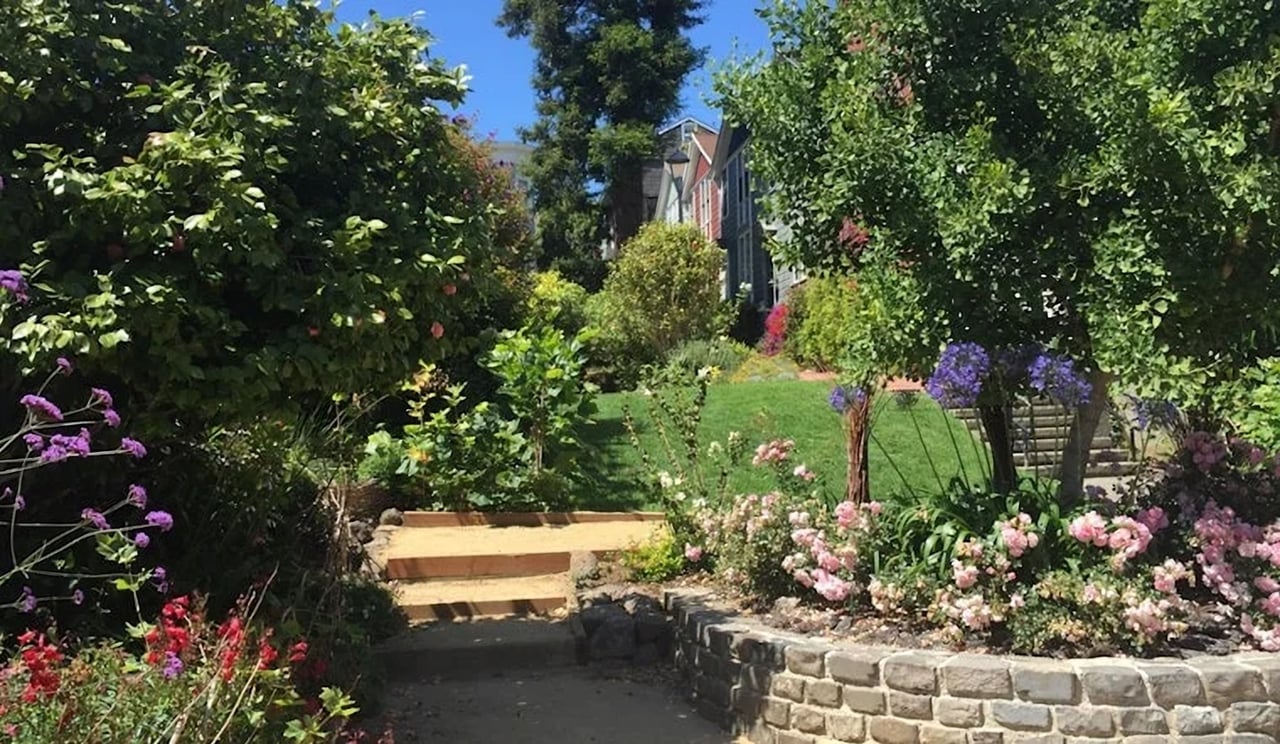
A car-free brick walkway, a row of 1882 cottages, and the "Japan Street" story every owner nearby should know.
Sean Mamola | October 22, 2026
A Saturday Halloween runs from a Church Street dog parade to Fair Oaks after dark

Sean Mamola | October 19, 2026
Off-market or on the MLS? A 2026 guide for San Francisco condo sellers.

Sean Mamola | October 16, 2026
How a 1031 exchange defers capital gains on a San Francisco investment property.

CONTACT SEAN MAMOLA AT RISES.CO
CA DRE# 02056250
891 Beach St.,
San Francisco CA 94109