Cottage Row: The Victorian Lane Hiding a Block Off Fillmore Street
Sean Mamola | October 23, 2026
Sean Mamola | October 23, 2026
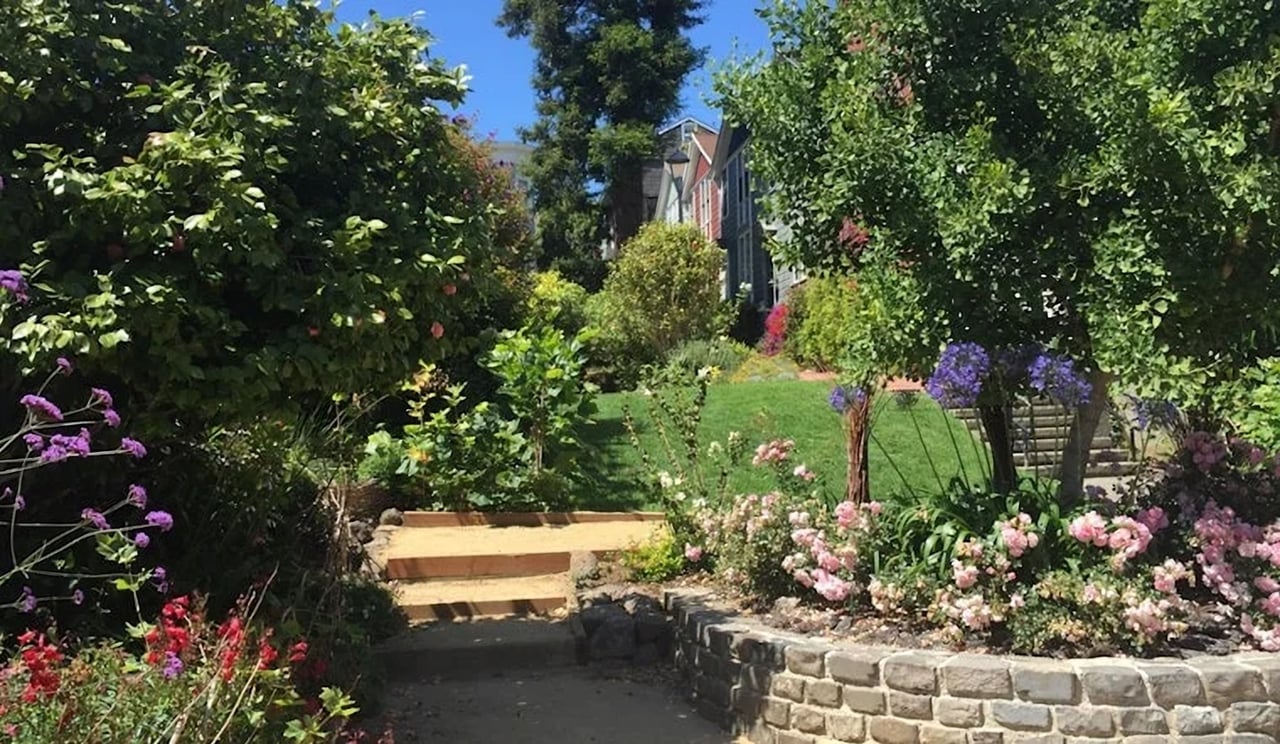
Cottage Row is a car-free brick walkway that runs mid-block from Bush Street to Sutter Street, between Webster and Fillmore, lined with six small wood-frame houses built in 1882. It's the heart of the Bush Street-Cottage Row Historic District, a San Francisco landmark district of about 20 Victorian houses built between roughly 1870 and 1885. You can walk it any day, and most people who live a few blocks away have never noticed it's there.
Key Findings
Cottage Row sits on the block bounded by Bush, Sutter, Webster and Fillmore, right where Lower Pacific Heights meets Japantown. By the MLS map, it's Lower Pacific Heights. SF Planning files the district under Japantown, and honestly both are fair. Japan Center is two blocks south, and Fillmore Street's shops are a block west.
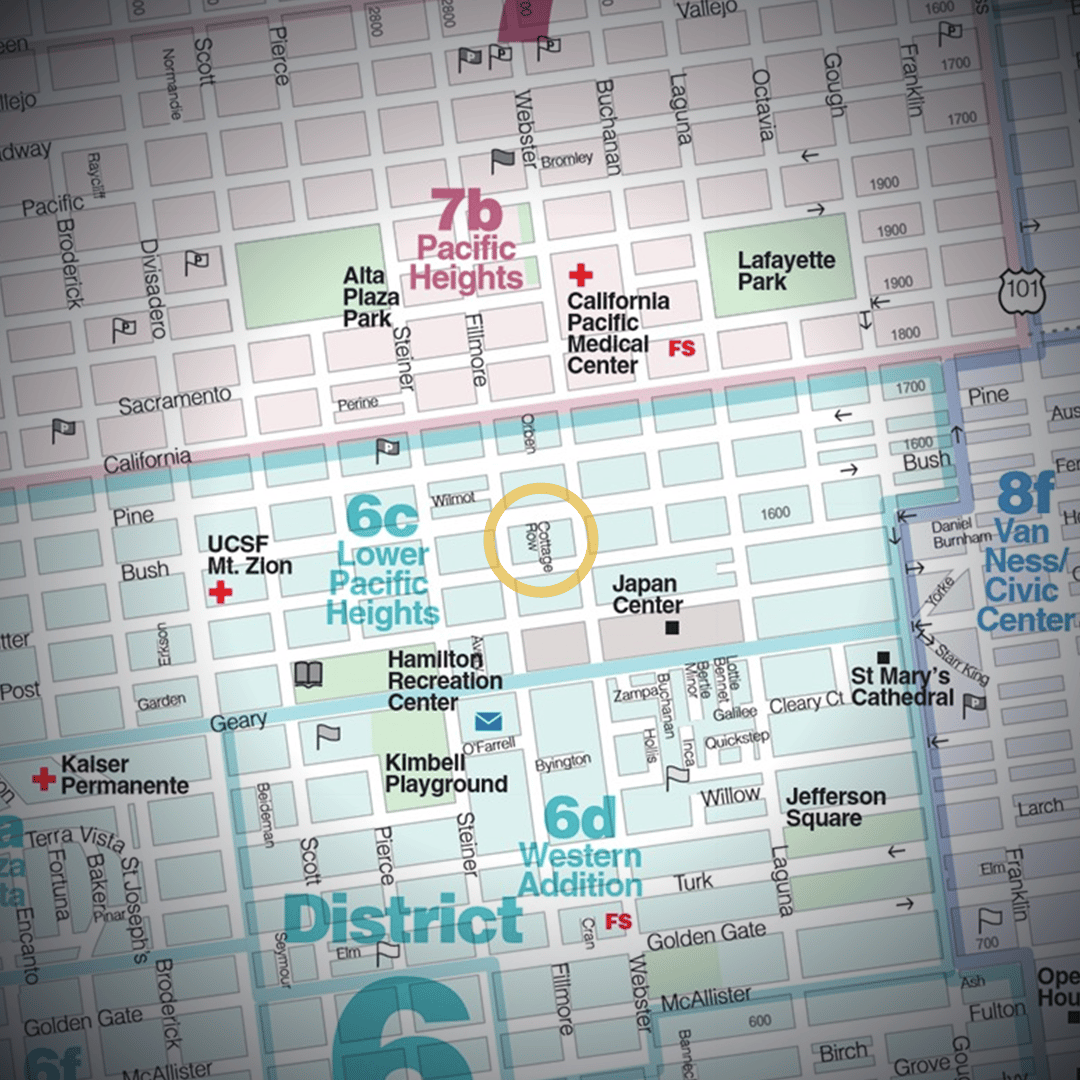
The entrances are easy to miss. On Bush, you're looking for a narrow opening in the middle of the block. On Sutter, look for the garden. Hoodline's write-up on the park tells you to watch for a small flight of stairs and a sign that reads "Cottage Row." Walk in from either end and the street noise drops away within a few steps. That's the surprise I love about this place, and I live just down the street, so I get to have it more often than most. You're a block from one of the busiest shopping streets in the city, and you're standing on a car-free (yes, I said car-free) brick lane between two rows of porches.
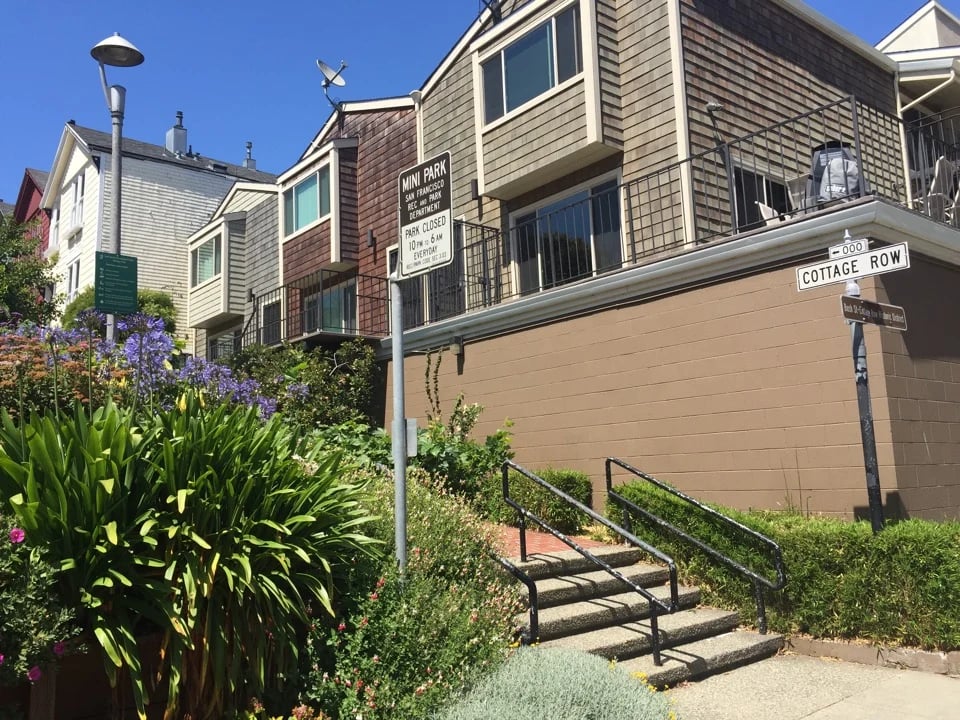
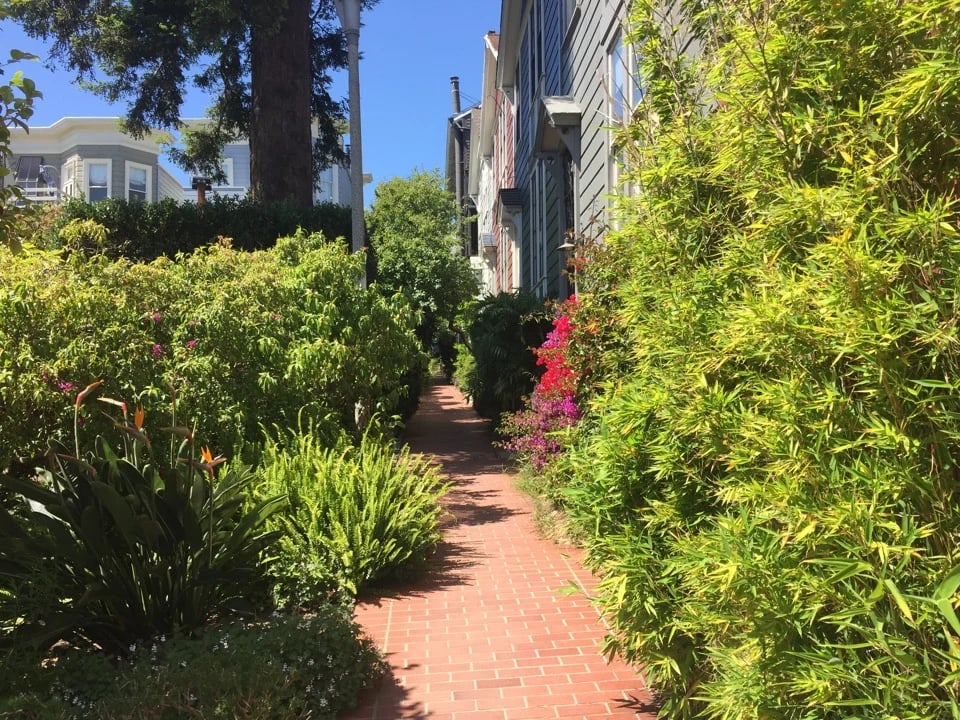
Most times when I'm riding my bike down Bush, I like to live a little and brake. Get it? Brake, as in bicycle brakes? Anyway, I like to take a nice, slow stroll down Cottage Row. It calms me down. The path itself is brick, and you can almost picture the late-night hustle and bustle this block must have seen in its day.
The district covers more than the Row itself. It wraps the block, taking in two stretches of Bush Street, the cottages, a pair of houses on Sutter and a pair on Webster.
Address | What's there | Built |
|---|---|---|
2101-2107 Bush | Italianate rowhouses built by Charles L. Taylor | 1874 |
2109 Bush | Taller, simpler Stick-style rental Taylor built to screen the cottages from the street | After 1882 |
2115-2125 Bush | Six flat-front Italianate houses by The Real Estate Associates | 1875 |
1-6 Cottage Row | Six two-story frame cottages Taylor built as rentals | 1882 |
1942-1948 Sutter | Two houses by The Real Estate Associates, the only two left on that side | 1875 |
1717-1719 Webster | Italianate duplex, plus an 1885 Stick-style house moved onto the 1717 lot | Duplex 1869, house moved 1974 |
Almost everything here is two stories, wood frame, and either Italianate (bracketed cornices, tall narrow windows) or early Stick style. Several of the Bush Street houses have angled bay windows, which SF Planning credits The Real Estate Associates with popularizing.
Here's the detail I find most telling. When Taylor finished the cottages, he built 2109 Bush taller than its neighbors, partly to shield the Row from the street. He was protecting the quiet of the lane in the 1880s. That quiet is still the whole appeal today.
Two very different developers shaped this block.
The Real Estate Associates, usually shortened to TREA, was San Francisco's largest housing developer of the 1870s. It worked from standard designs at different price points, a bit like a production homebuilder today. TREA built the six flat-front Italianate houses (Google it) at 2115-2125 Bush and the two Sutter Street houses in 1875. Of the roughly 1,000 houses TREA put up across the city, only about 200 remain, so a surviving row of six is rare.
Charles L. Taylor was a smaller investor. He built the rowhouses at 2101-2107 Bush in 1874, then in 1882 bought the narrow strip of land running through the middle of the block. He had six cottages built there as rentals and named the lane Cottage Row, which seems fitting and easy. SF Planning's walking tour notes the original records call them "tenements," which back then simply meant rental housing.
According to Hoodline, the layout borrows from the English mews, a group of connected homes that share a common path or green, and the cottages stayed rentals until they were converted to owner-occupied single-family homes in the late 1950s and early 1960s. That second detail matters to me as an agent. The Row didn't start as a place you could buy into. It became one about 75 years after it was built, and that's the version of Cottage Row that exists today.
In the 1930s, Cottage Row was home to Japanese American families, and people in the neighborhood called the walkway "Japan Street." Residents grew vegetables in the small back yards behind the cottages and sold them at an informal market along the Row every Saturday.
That community ended because the federal government ended it. During World War II, Japanese Americans in San Francisco were forcibly removed from their homes and incarcerated in camps, and the families of Cottage Row were among them. The district's own history says it plainly: this was a predominantly Japanese American block until that removal.
I don't think you can understand this lane, or Japantown, without that chapter. The houses survived. The people who made the Row a neighborhood in the 1930s were taken from it. Today the Sutter Street end of the park has a garden honoring the Issei, the first generation of Japanese immigrants, and it's worth stopping there on your way in or out. It's subtly moving, to say the least.
In the 1960s and 70s, redevelopment cleared much of the surrounding Western Addition, including blocks of Victorian houses around Japantown. This block mostly made it through, though not untouched. Taylor's original rowhouse at 1717 Webster was demolished in 1974. That same year, a Stick-style house built in 1885 on Turk Street was moved onto the lot, which is why the 1717 address is a Victorian that didn't start life here.
Recognition followed. The district was listed on the National Register of Historic Places on December 27, 1982, and San Francisco designated it a local landmark district under Article 10 of the Planning Code in September 1991.
Cottage Row Mini Park runs alongside the walkway. It's a landscaped brick path with benches and the cottage porches on one side. It isn't a park for a picnic blanket or a ball game. It's a place to walk through slowly, or to sit for ten minutes with a coffee from Fillmore. The city's Recreation and Park Department owns and maintains it, and Hoodline's 2016 piece describes neighbors using it for sunbathing and dog walking, which is about the right scale for it.
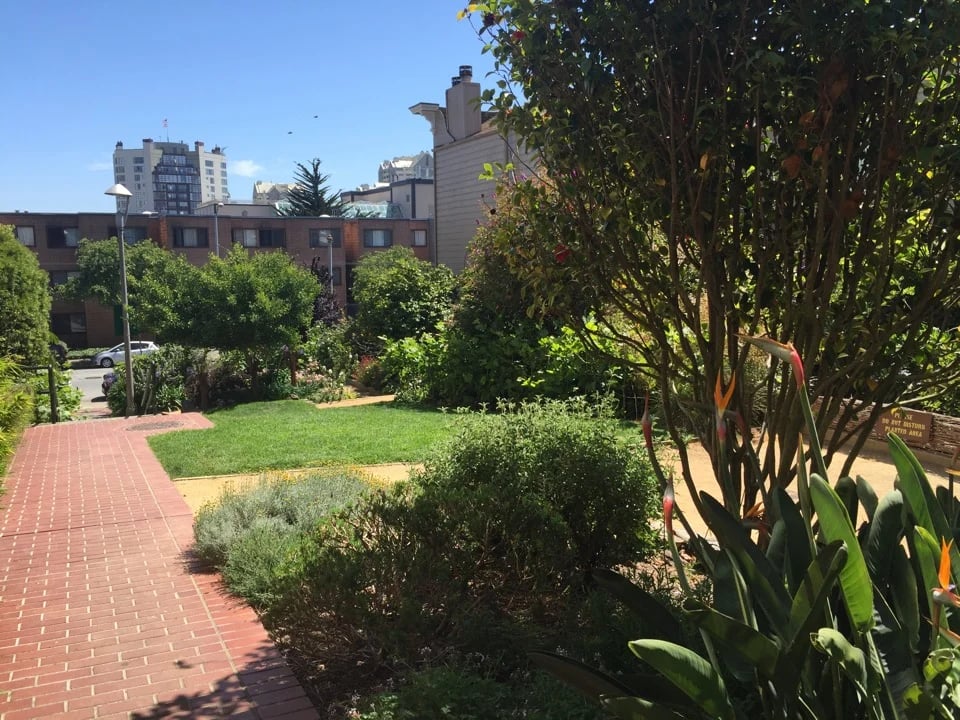
SF Rec & Park recently renovated the Sutter Street frontage in partnership with the Japanese Cultural and Community Center of Northern California, adding the garden honoring the Issei.
One courtesy note. Every house on the Row is privately owned and lived in. The path and park are public, but the porches and the people on them aren't part of the attraction. Walk through the way you'd want someone to walk past your front door. That means no loud phone calls and no speakerphone on this serene, bespoke little strip of quiet city love.
This is the part buyers ask me about. Owning in a San Francisco landmark district doesn't mean you can't change anything. It means changes to the outside of the building get a historic review before you get a permit.
Here's how it works in general terms, based on SF Planning's Certificate of Appropriateness page as of this writing:
Review centers on the exterior. A kitchen or bath remodel inside usually isn't what triggers it, but a new window, a rear addition or a change to the facade can be.
This is general information, not legal advice. Before you buy or plan a project, call the Planning Counter (628.652.7300 or [email protected]) or talk to an architect who's worked on San Francisco landmarks.
My take is that the review cuts both ways, and that's the point. You give up some freedom on your own exterior. In exchange, nobody on the block can tear down a Victorian or put a glass box on the Row next to you. In a neighborhood that lost so much in the 1960s and 70s, that protection is a big part of why this block still looks the way it does.
From experience: the buyers who are happiest in older, protected buildings are the ones who price the timeline before they price the project. The renovation budget is usually the easy number. The months it takes to get through review are what catch people off guard, so I'd build that into the plan from day one.
For buyers. Homes in the district rarely come up (Hoodline noted the same thing back in 2016), and when one does, you're buying a Victorian with rules attached. Read the district's Article 10 section before you write an offer, and if you're planning exterior work, get an architect's opinion on what's realistic. The same goes for the blocks just outside the district. You get the walk to the Row without the review.
For sellers. The history is the marketing. A house on or next to Cottage Row has a story very few homes in Lower Pacific Heights can match. Have your permit history and any past COA approvals organized before you list, because buyers of historic homes will ask.
For the luxury market. The condos and flats within a few blocks of the Row trade on walkability to Fillmore and Japantown, and a hidden lane like this is part of that lifestyle story. It's not a price driver you'll see in a comp, but it's the kind of detail that makes a buyer pick this neighborhood over another. My guide to buying a condo in Lower Pacific Heights covers the buildings themselves.
If you're making a day of it, Japan Center is two blocks south. Peace Plaza is nearly back after its renovation, and I wrote up what's changed on Fillmore Street and in Japantown this year, which sits in the Western Addition on my site.
Oh, and make your way to Yasukochi's Sweet Stop, the famous little bakery inside Super Mira at the corner of Sutter and Buchanan. The lovely lady behind the counter sells coffee crunch cake for $8 a slice, and it's usually gone before noon.
Where is Cottage Row in San Francisco?
Cottage Row runs mid-block from Bush Street to Sutter Street, between Webster and Fillmore. It sits where Lower Pacific Heights meets Japantown, a block from Fillmore Street's shops and two blocks from Japan Center.
Can you walk through Cottage Row?
Yes. The walkway and Cottage Row Mini Park are public, and you can enter from Bush or Sutter. The houses along it are private homes, so keep it quiet and stay on the path.
When were the Cottage Row houses built?
The six cottages on the Row were built in 1882. The wider district's houses date from about 1870 to 1885, mostly Italianate and early Stick-style, two stories and wood frame.
Why was Cottage Row called "Japan Street"?
In the 1930s, Japanese American families lived on the Row, grew vegetables in their back yards and held a Saturday market there. The community ended when they were forcibly removed and incarcerated during World War II.
Is Cottage Row a historic landmark?
Yes. The Bush Street-Cottage Row Historic District was listed on the National Register of Historic Places on December 27, 1982, and designated a San Francisco Article 10 landmark district in September 1991.
Do I need approval to renovate a house in the district?
Most exterior work that needs a City permit also needs a Certificate of Appropriateness from SF Planning. Smaller jobs may qualify for an Administrative COA that staff can approve. Confirm the current rules with SF Planning before you plan any project. This is general information, not legal advice.
Curious what it's like to own near a hidden corner of San Francisco like Cottage Row, or what a home on a historic block is worth? Sean Mamola is a Global Luxury Specialist with Compass and a Bay Area native with 17+ years of experience, from entry-level condos to an $8.7M South Beach penthouse. He lives just down the street from Cottage Row, knows Lower Pacific Heights and Japantown block by block, and he can walk you through what landmark rules mean for a purchase before you write an offer.
Schedule a consultation or call (415) 704-3640.
Photos: Nuala Sawyer/Hoodline
Sources: SF Planning, Bush Street-Cottage Row walking tour. SF Rec & Park, Cottage Row Mini Park. SF Planning, Certificate of Appropriateness. Hoodline, "Secretly Awesome: Japantown's Cottage Row Mini Park" (2016).
Primary phone
(415) 704-3640License Number
#02056250Address
891 Beach StSean Mamola is a San Francisco real estate agent who specializes in luxury properties and penthouses throughout the city's most coveted neighborhoods. As a Global Luxury Specialist with Compass and Rises.co, Sean works with discerning clients who are buying and selling exceptional properties in San Francisco. Since 2018 he has closed 75+ transactions and more than $100M in sales volume across the city's high-rise condo and penthouse market.
Sean focuses on San Francisco's premier areas including South Beach, Yerba Buena, Mission Bay, Pacific Heights, Lower Pacific Heights, Russian Hill, and Nob Hill. His deep knowledge of these neighborhoods allows him to guide clients to properties that perfectly match their lifestyle and investment goals.
Whether you're drawn to the modern luxury of South Beach condos, the urban sophistication of Yerba Buena, the waterfront appeal of Mission Bay, the timeless elegance of Pacific Heights, the historic charm of Russian Hill, or the prestigious heights of Nob Hill, Sean understands what makes each area unique.
For Sellers
Sean creates comprehensive marketing strategies that attract qualified buyers with refined tastes. He believes in elegant staging with meticulous attention to detail, ensuring your property makes an unforgettable impression. His marketing reaches both international and local luxury markets, maximizing exposure for condos, penthouses, condotels, and new developments.
For Buyers
Using cutting-edge technology and market research, Sean carefully analyzes pricing and property trends to find homes that satisfy his clients' specific preferences, price points, and lifestyles. His 24/7 availability and white-glove service ensure you never miss the right opportunity.
Working with Sean and his partnership with Rises.co gives clients significant competitive advantages. His vast network of interconnected agents results in winning offers and an impressively low ratio of properties shown to offers accepted. Sean's impeccable work ethic and precise negotiation skills ensure sellers find the right buyer and buyers secure their dream home.
Before becoming a licensed real estate agent, Sean spent years in luxury hospitality, skills he applies to every client relationship and transaction. He has tremendous respect for people's privacy and consistently exceeds expectations – from international travel to execute transactions to handling unique special requests.
As a Bay Area native who lived in New York City for 15 years, Sean brings a global perspective and genuine appreciation for people from all walks of life. His diverse background helps him connect with clients whether they're local San Francisco residents or international buyers seeking their perfect property.
When not working, Sean enjoys cycling, spending time with his large Irish-Italian family, and volunteering for Food Runners, The Richmond/Ermet Aid Foundation (REAF), and Broadway Cares/Equity Fights AIDS. This community involvement reflects his commitment to giving back to the city he serves.
If you're looking for an exceptional San Francisco real estate agent who specializes in luxury properties and provides truly high-touch service, let's talk. Sean is ready to help you find your perfect San Francisco home or achieve the best possible outcome when selling your property.
Specializing in luxury condos, penthouses, and exceptional properties in South Beach, Yerba Buena, Mission Bay, Pacific Heights, Lower Pacific Heights, Russian Hill, and Nob Hill.
Stay up to date on the latest real estate trends.
Sean Mamola | October 23, 2026
A car-free brick walkway, a row of 1882 cottages, and the "Japan Street" story every owner nearby should know.
Sean Mamola | October 22, 2026
A Saturday Halloween runs from a Church Street dog parade to Fair Oaks after dark
Sean Mamola | October 19, 2026
Off-market or on the MLS? A 2026 guide for San Francisco condo sellers.
Sean Mamola | October 16, 2026
How a 1031 exchange defers capital gains on a San Francisco investment property.

Sean Mamola | October 15, 2026
One construction fence comes down, and another goes up across Post Street.
Sean Mamola | October 15, 2026
The disclosures and reports a San Francisco seller must provide in 2026.
Sean Mamola | October 14, 2026
What Yerba Buena condo buyers need to know in 2026: value, buildings, and leverage.
Sean Mamola | October 13, 2026
What Mission Bay condo buyers need to know in 2026: prices, buildings, and pace.
Sean Mamola | October 12, 2026
Two-thirds of condos sold over asking and the median rose 23%. Then mortgage rates climbed to 7.40%. Here's how I'm reading both.
CONTACT SEAN MAMOLA AT RISES.CO
CA DRE# 02056250
891 Beach St.,
San Francisco CA 94109